
STRATEGIC INSIGHTS & ARTICLES
At Jefferies & Partners, this is where we bring together the ideas, signals, and perspectives shaping modern leadership and organisational performance. From our own articles to partner white papers and curated external insight, this page is designed for leaders who need more than noise and headlines.
We focus on the issues that matter most: strategy, transformation, technology, governance, and decision-making under pressure. The aim is simple. To help leaders think more clearly, judge more effectively, and act with greater confidence in a fast-changing environment.
THOUGHT LEADERSHIP & WHITE PAPERS

Jefferies & Partners. April Whitepaper:The Future of Leadership in the Algorithmic Age.
Artificial intelligence is changing more than productivity. It is changing how judgement is formed, how decisions are communicated, and how leadership is exercised inside organisations.
In this first white paper from Jefferies & Partners., we explore one of the defining leadership questions of the current moment: what happens when human judgement is increasingly shaped by intelligent systems?
As AI becomes more embedded in business, the challenge is no longer simply whether organisations will use it. The challenge is how leaders use it without weakening accountability, trust, and the human responsibility to decide.
This paper sets out our perspective on algorithmic leadership, the risks of machine-shaped decision-making, and why strong governance and visible human judgement still matter.

Artificial Intelligence Index Report: Standford Human-Centered Artificial Intelligence
As AI continues to advance rapidly, the question becomes whether the systems built around it can keep up. Governance frameworks, evaluation methods, education systems, and the data infrastructure needed to track AI’s impact are struggling to match the pace of the technology itself. That gap-between what AI can do and how prepared we are to manage it-runs through every chapter of this year’s report. New in this edition, the report tracks how AI is being tested more ambitiously across reasoning, safety, and real-world task execution, and why those measurements are increasingly difficult to rely on. It also features new estimates of generative AI’s economic value alongside emerging evidence of its labor market effects, an analytical framework on AI sovereignty, and a science chapter developed in collaboration with Schmidt Sciences. For the first time, the report features standalone chapters on AI in science and AI in medicine, reflecting AI’s growing impact across these two domains.

Bridging the ERP Gap: How Connecting Your ERP and CPM Changes How Finance Works
As AI continues to advance rapidly, the question becomes whether the systems built around it can keep up. Governance frameworks, evaluation methods, education systems, and the data infrastructure needed to track AI’s impact are struggling to match the pace of the technology itself. That gap-between what AI can do and how prepared we are to manage it-runs through every chapter of this year’s report. New in this edition, the report tracks how AI is being tested more ambitiously across reasoning, safety, and real-world task execution, and why those measurements are increasingly difficult to rely on. It also features new estimates of generative AI’s economic value alongside emerging evidence of its labor market effects, an analytical framework on AI sovereignty, and a science chapter developed in collaboration with Schmidt Sciences. For the first time, the report features standalone chapters on AI in science and AI in medicine, reflecting AI’s growing impact across these two domains.
RECOMMENDED READING FOR LEADERS
In an age of noise, cognitive overload, and constant media bombardment, books remain one of the most powerful tools for deep learning.
At Jefferies & Partners., we believe strong leadership is shaped not only by action, but by reflection. Leaders are often pulled from one urgent issue to the next, solving immediate problems under constant pressure. Reading creates something different. It creates space to think, to question, to sharpen judgement, and to reclaim time for deeper consideration.
Some of the titles featured here may not appear immediately relevant to management consulting or organisational transformation. That is intentional. How a leader thinks about the world often shapes how they approach the problem in front of them. Strategy, execution, culture, power, economics, human behaviour, and institutional change do not sit in neat boxes. The broader the perspective, the sharper the insight.
This curated selection has informed our thinking on strategy, execution, culture, leadership, and transformation. We hope these books do more than inform. We hope they challenge assumptions, deepen critical thinking, and offer an edge in how you read the world around you.


BOOK: Thinking, fast and slow: Daniel Kahneman
This book sharpens one of the most important capabilities in leadership: judgment. Kahneman shows how fast, intuitive thinking can help us move quickly, but also how easily it can expose leaders to bias, assumption, and flawed decisions. For anyone leading through complexity, change, or uncertainty, this is essential reading on why clear thinking matters, and how better decisions are made.

BOOK: TThe Ascent of Money: A Financial History of the World: 10th Anniversary Edition
In this updated edition, Niall Ferguson brings his classic financial history of the world up to the present day, tackling the populist backlash that followed the 2008 crisis, the descent of "Chimerica" into a trade war, and the advent of cryptocurrencies, such as Bitcoin, with his signature clarity and expert lens.
The Ascent of Money reveals finance as the backbone of history, casting a new light on familiar events: the Renaissance enabled by Italian foreign exchange dealers, the French Revolution traced back to a stock market bubble, the 2008 crisis traced from America's bankruptcy capital, Memphis, to China's boomtown, Chongqing. We may resent the plutocrats of Wall Street but, as Ferguson argues, the evolution of finance has rivaled the importance of any technological innovation in the rise of civilization. Indeed, to study the ascent and descent of money is to study the rise and fall of Western power itself.

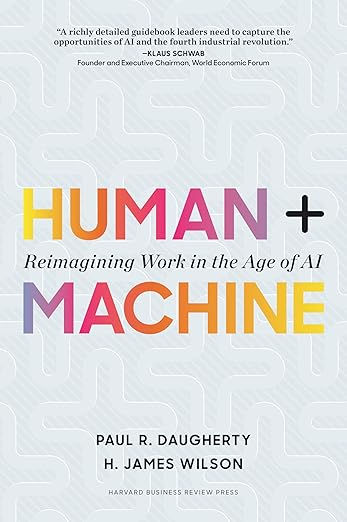
BOOK: Human + Machine: Reinmagining Work in the Age of AI
For today’s leaders, understanding AI is no longer optional, it’s a strategic advantage. Human + Machine gives a clear, practical view of what AI actually does inside organisations: where it adds value, how it reshapes workflows, and why augmentation-not automation-is the real opportunity. This book moves beyond buzzwords, grounding AI in real use cases that executives can apply to complex, multi-team projects and transformation agendas.
For leaders overseeing large programmes, cross-functional initiatives, or heavy operational environments, the insights are immediate: AI can enhance decision-making, accelerate delivery, elevate quality, and unlock new forms of problem-solving that humans alone cannot achieve. The future belongs to organisations that treat AI as a learning capability-not a tool-and equip their people to work alongside intelligent systems with confidence and curiosity.
BOOK: The Most Important Thing : Mastering Judgment, Risk, and the Discipline of Clear Thinking
In leadership, as in investing, the greatest differentiator is not access to information, it’s the quality of judgment. Howard Marks’s classic work distils decades of high-stakes decision-making into a set of principles that go far beyond finance. At its core, this book is about how leaders think: how they assess risk, recognise patterns, avoid blind spots, and maintain discipline in uncertain environments.
For executives steering organisations through volatility, Marks provides a rare gift: a framework for making sound decisions when the data is incomplete, the pressure is high, and the consequences are real. His insights mirror the realities leaders face every day, navigating ambiguity, challenging consensus thinking, and balancing conviction with humility.

BOOK: The Moral Molecule: The Science Behind Trust, Cooperation, and High-Performing Cultures
In leadership and organisational life, trust is often treated as an abstract value, something we claim to prioritise but rarely understand at a biological level. The Moral Molecule challenges that gap. Dr. Paul Zak’s groundbreaking work reveals how a single neurochemical mechanism can shape empathy, generosity, reliability, and the behaviours that determine whether teams thrive or fracture.
For leaders navigating complexity, this book offers a powerful lens: culture is not just built through systems and processes, it is built through human chemistry. When organisations understand what drives trust and cooperative behaviour, they can design environments where people choose to collaborate, take responsibility, and act with integrity.

BOOK: Prediction Machines: The Economics of AI and the Future of Strategic Decision-Making
Prediction Machines reframes AI in a way every leader should understand: not as magic, but as a dramatic reduction in the cost of prediction. Once you see AI through this lens, its strategic value becomes clear. Better prediction improves decisions, reduces uncertainty, and opens entirely new paths for competitive advantage.
For leaders running complex programmes or shaping long-term strategy, this book provides a simple but powerful framework for understanding how AI actually creates value inside an organisation, whether in operations, risk, customer engagement, or large-scale transformation work. It shows how AI augments teams, not by replacing people, but by enhancing their ability to anticipate, plan, and act with greater precision.
In a world where uncertainty constrains strategic choices, learning this model equips leaders to design smarter systems, structure more resilient projects, and position their organisations for the coming wave of AI-enabled opportunity.

BOOK: Boards That Deliver: Turning Governance into Strategic Advantage
At the highest levels of leadership, good governance is not about compliance, it’s about capability. Boards That Deliver cuts through the theory and gets to the heart of why many boards struggle: increased time and effort aren’t translating into better decisions, stronger oversight, or clearer strategic direction. Ram Charan reframes governance as a performance system, showing how effective boards create value by improving judgment, sharpening strategy, and enabling CEOs and executive teams to lead with confidence.
For organisations navigating growth, transformation, or heightened complexity, this book offers a blueprint for moving from passive oversight to active, strategic partnership. It demonstrates how boards can become true competitive advantages—driving succession excellence, strengthening decision-making, reducing friction at the top, and ensuring the organisation is equipped to meet its long-term ambitions.

BOOK: Enterprise Architecture as Strategy: Building the Operating Model That Makes Strategy Real
Many organisations don’t fail because of poor strategy, they fail because their strategy cannot be executed. Enterprise Architecture as Strategy provides a decisive insight for modern leaders: competitive advantage increasingly depends on the strength of your operating model and the digital foundations that support it. Ross, Weill, and Robertson show how smart companies identify the few processes they must execute exceptionally well, then design the systems and architecture that make those capabilities scalable, reliable, and repeatable.
For leaders running complex programmes or multi-year transformations, this book highlights a critical truth: without the right architectural backbone, speed, efficiency, and alignment all break down. By clarifying the operating model and digitising core processes, organisations can dramatically improve performance, reduce complexity, and turn strategic intent into consistent, enterprise-wide execution. This is essential reading for executives who want strategy to move beyond the slide deck—and into measurable impact.

BOOK: Tokens
Wherever you look, money is being re-placed by tokens. Digital platforms are issuing new kinds of money-like things: phone credit, shares, gift vouchers, game tokens, customer data—the list goes on. But what does it mean when online platforms become the new banks? What new types of control and discrimination emerge when money is tied to specific apps or actions, politics or identities?
Tokens opens up this new and expanding world. Exploring the history of extra- monetary economies, Rachel O’Dwyer shows that private and grassroots tokens have always haunted the real economy. But as the large tech platforms issue new money-like instruments, tokens are suddenly everywhere. Amazon’s Turk workers are getting paid in gift cards. Online streamers trade in wishlists. Foreign remittances are sent via phone credit. Bitcoin, gift cards, NFTs, customer data, and game tokens are the new money in an evolving economy. It is a development challenging the balance of power between online empires and the state. Tokens may offer a flexible even subversive route to compensation. But for the platforms them-selves they can be a means of amassing frightening new powers.
An essential read for anyone concerned with digital money, inequality, and the future of the economy.

BOOK: McKinsey's Playbook on How Leading Companies Win with Technology and AI 2nd Edition
In the newly revised second edition of Rewired: The McKinsey Playbook on How Leading Companies Win with Technology and AI, five experienced McKinsey leaders deliver an essential and incisive update to their widely read guide to planning and implementing successful Tech & AI transformations.
The book walks you through the six capabilities every company must develop to succeed with Tech & AI: transformation roadmapping that targets real value, a talent bench of highly skilled experts, an operating model that allows you to move at pace, a distributed technology environment that is flexible, data embedded throughout your organization, and adoption and scaling that enable solutions to realize meaningful gains.
This new edition offers brand new insights into cutting-edge AI solutions―and what it takes to implement them―as well as the new economics of Tech & AI transformations. You’ll also discover how to build up the “tech muscles” of your AI transformation leaders, how to develop effective human-AI collaboration models, how to revolutionize software develop with AI agents, and how to industrialize AI so it can safely and effectively scale.

BLOG














GLOBAL SIGNALS
55%
Business AI Adoption
AI business usage is also accelerating: 78% of organizations reported using AI in 2024, up from 55% the year before.
3.4 Million
AI adoption is accelerating across essential industries, from healthcare to mobility. In 2024 alone, more than 3.4 million people interacted with AI-powered systems in high-impact environments - including autonomous transport, medical diagnostics, and safety-critical decision-support tools.
72%
AI adoption is accelerating worldwide.
In 2025, 72% of organisations reported using AI in at least one business function—a rapid rise driven by more accessible models and lower costs.
Download Full Report: Artificial Intelligence Index Report 2025 by The Stanford Institute for Human-Centered AI (HAI)

Take the next step
Whether you're delivering a complex program, driving a digital transformation, or navigating strategic change, Jefferies & Partners is here to help you move forward, with clarity, control, and a values-driven approach.
Let’s start a conversation about where you’re headed, and how we can help you lead the work that gets you there.